From the desk of Philip Mitchell
Architectural Technologist, Edmonton
Dear Homeowner,I have three questions for you.Do you know when your furnace was last serviced?Do you know what it would cost to replace, if it quit on a Sunday in January?If a contractor handed you a repair quote tomorrow, would you know whether the price was fair?Most people cannot answer those, because a house doesn't tell you.Nothing beeps. Nothing turns red.A house that is fine and a house that has had water getting in for three years look the same from the kitchen. Who would think to check?That's the part that costs money: the three years.A crack in a foundation wall runs about five hundred dollars while it is still a crack.Once water is coming through that wall, you are into eight thousand.
From the estimator, Alberta: sealing one crack, about $500 to $1,500. Waterproofing one 40-foot basement wall, about $3,700 to $14,000.
Same wall, same house, all that changed was how long it sat there.The only people who look at a house are the people who get paid to fix it.And they show up after, never before.
As an architectural technologist, I look at houses for a living.I'm the person who draws them.I have no sale to make and no quote to write.From that side of the desk the issues are evident.From inside them, they feel perfectly fine.So most months you get the same quiet feeling that something needs attention,you just do not know what.
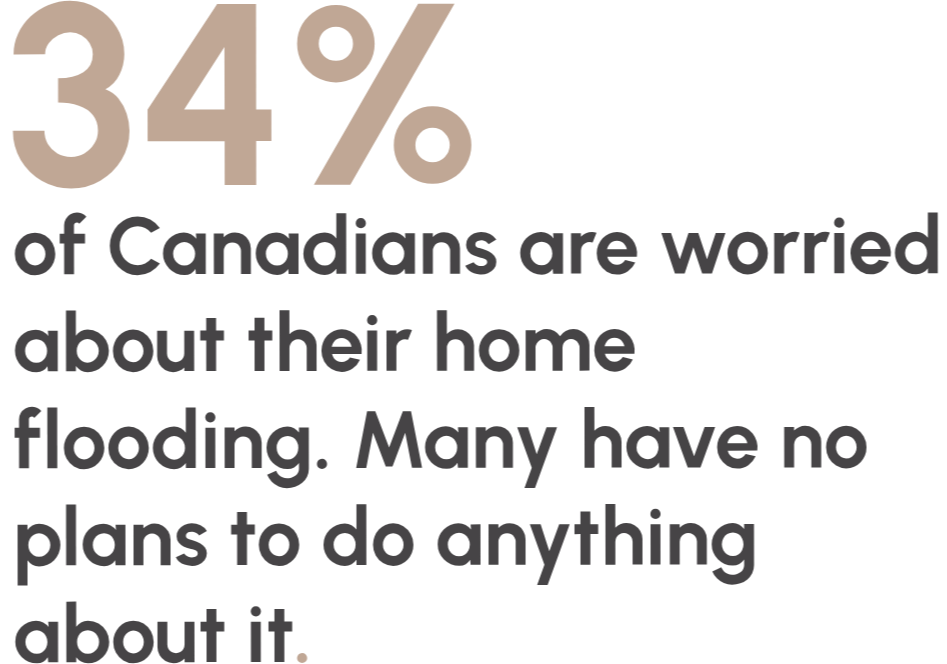
Léger for Allstate Canada · 1,527 Canadians · January 2026
That's a third of the country.They care. They just don't know where to start.Nobody ever told them what to do,and nobody told you either.There's nowhere sensible to look.Almost everything written about house maintenance is American.American weather, code, and most importantly prices.Frost depth, ice dams, when the ground freezes and when it lets go, all behave differently up here.Videos are fine for one job at a time,but they never show you the whole year, and leave you with a bunch of separate things to do.And almost none of it has a price attached.You can usually find out what to check,but finding out what it should cost, where you live, this year, is a different problem entirely.Sure, your insurer will send you a free checklist. So will the gas company.They tell you what to check, but they don't tell you what the work should cost where you live, or if a quote is fair.So I built what I kept wishing I could hand people.I trained at NAIT in Architectural Technology, and I work in residential design here in Alberta.Real houses in our rough climate.The same questions come up over and over, and there has never been a good place to send someone for the answer.A video, some online checklist, a contractor with a quote to write, none of it was a very good fit,so I wrote it all down.Everything to check, when to check it, and what the work should cost where you live.That’s The Canadian Home Maintenance System.It comes in three pieces:
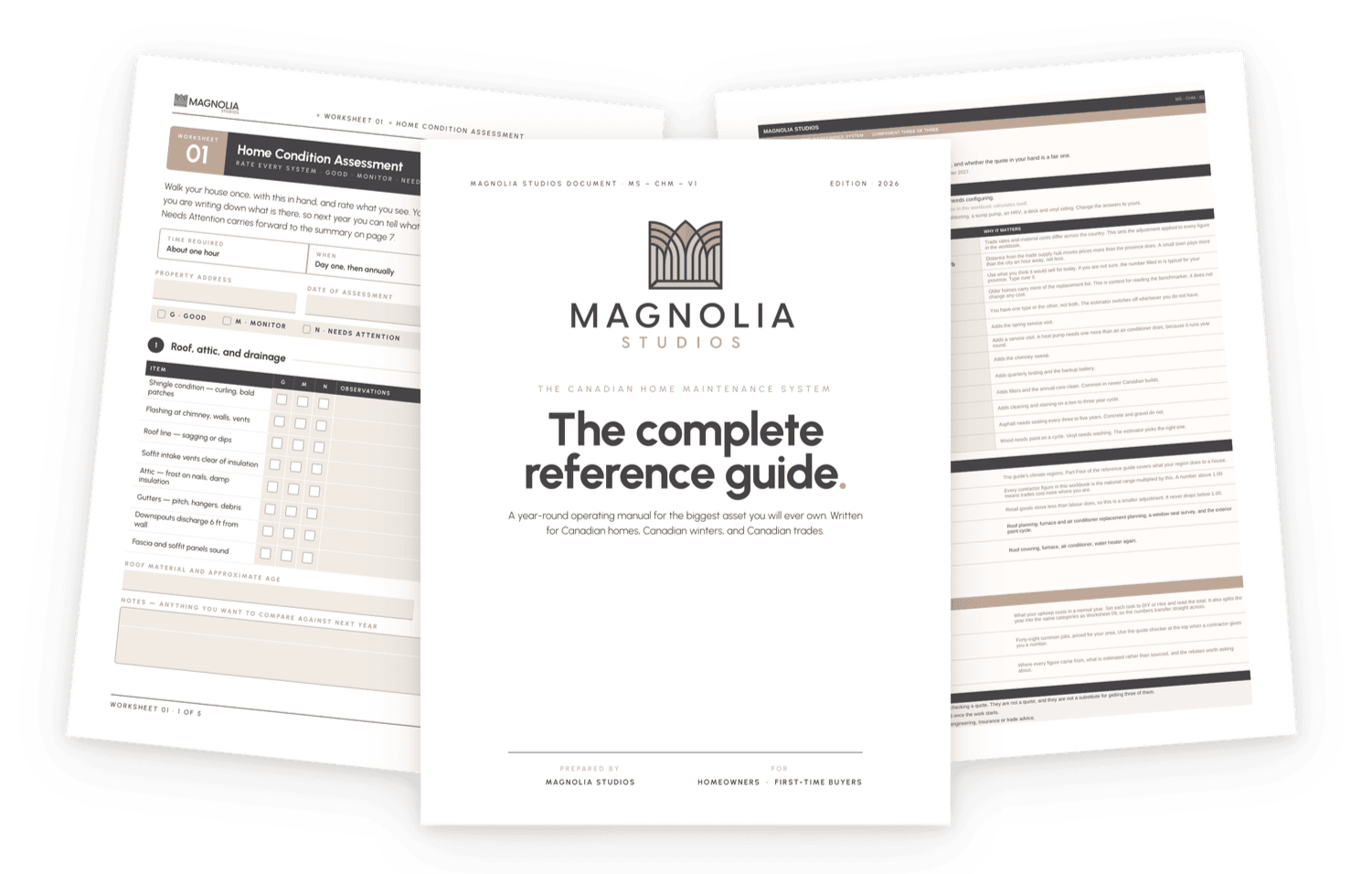
The Complete Reference Guide
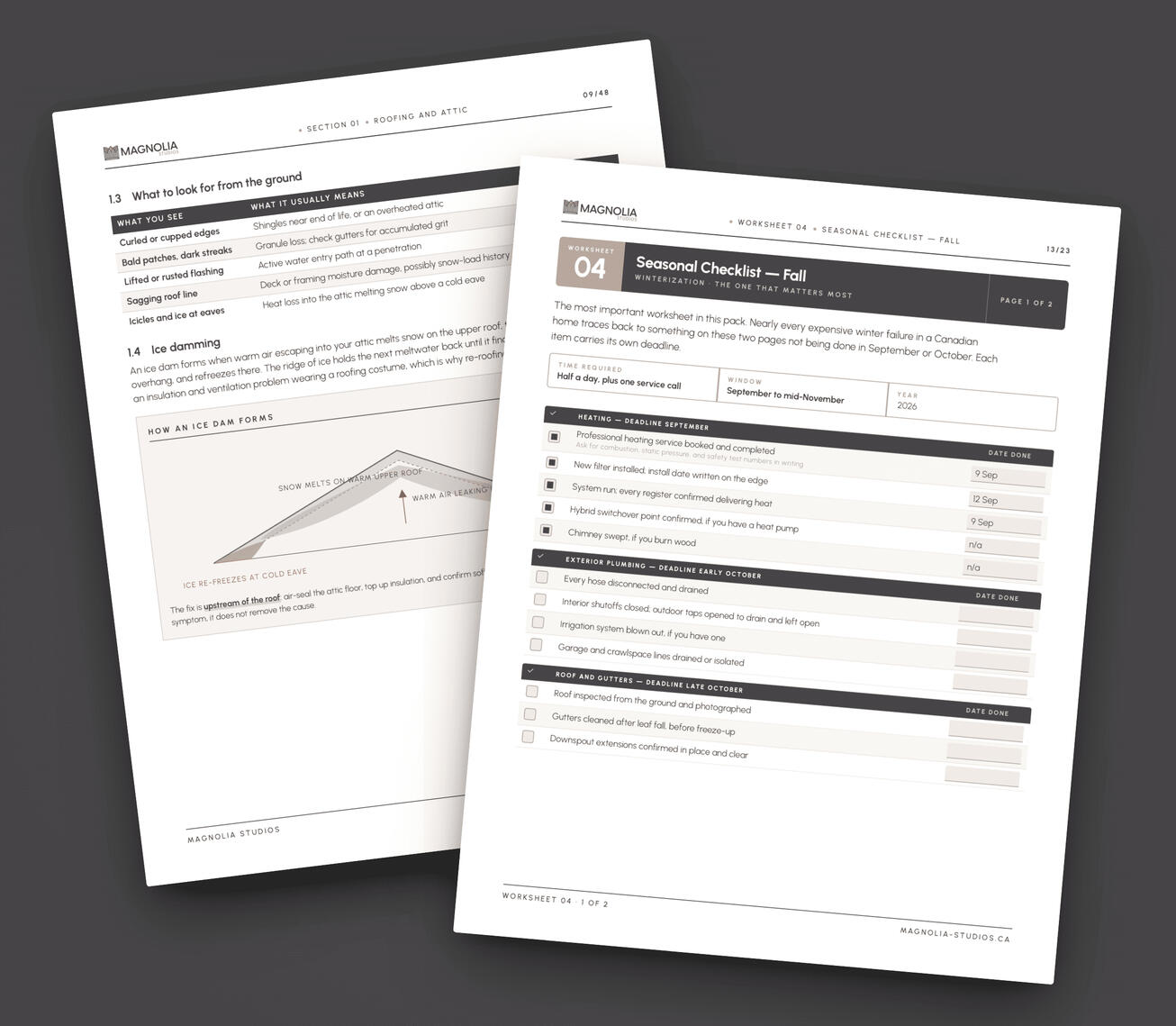
Every system in the house: what to look at, how often, and the point where it stops being a homeowner job.The Interactive Worksheet Pack
You fill it in on screen, or print it to paper. The assessment, the seasonal checklists, the contractor forms, and a permanent record of what you’ve done and when.The Home Cost Estimator
Answer a few questions once, and every price adjusts to your province, your home value, and what your house actually has.That’s it.It comes with no subscription, app, or anything to log into.Download the files locally and have them forever.But I'd rather show you than continue describing it.
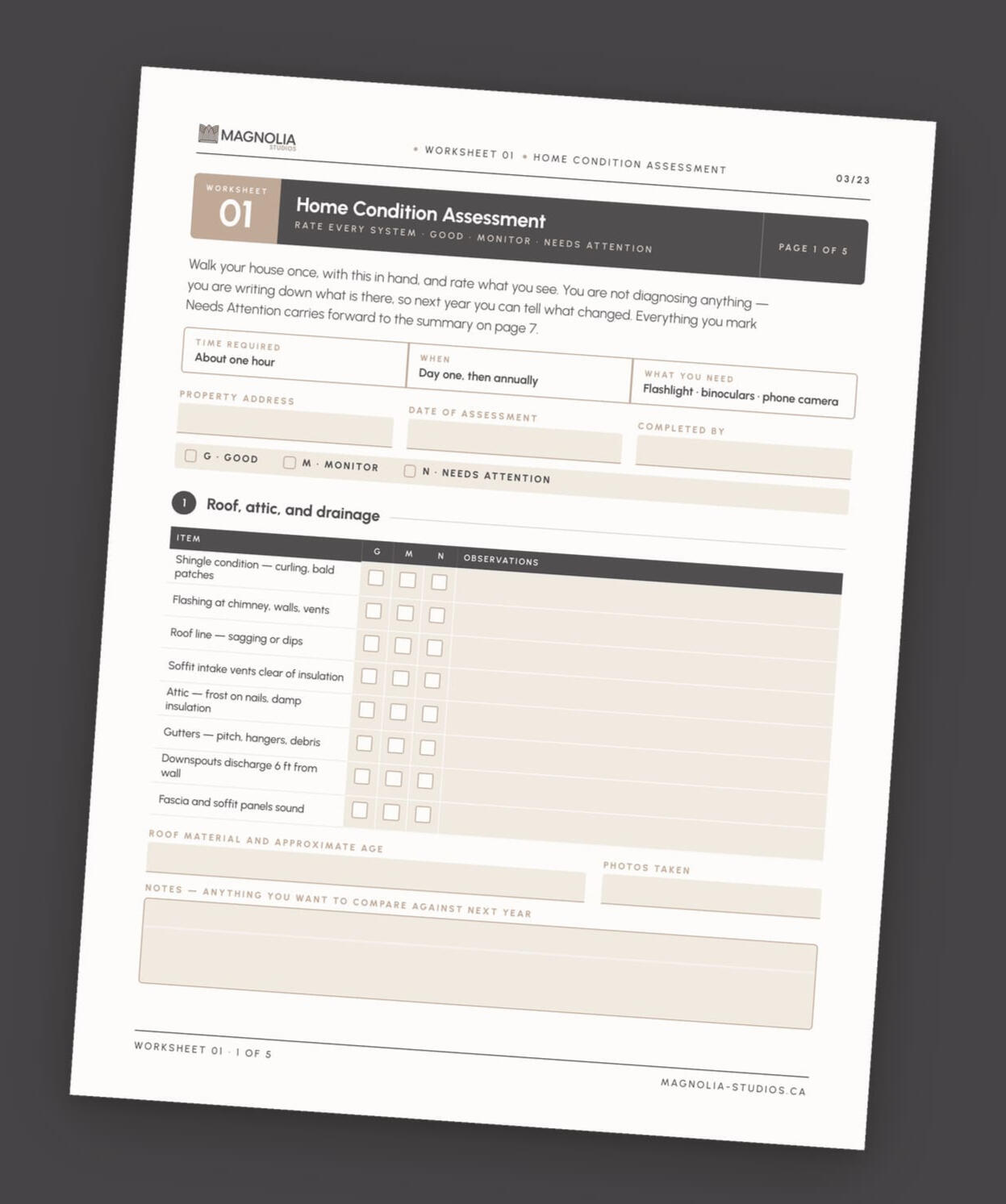
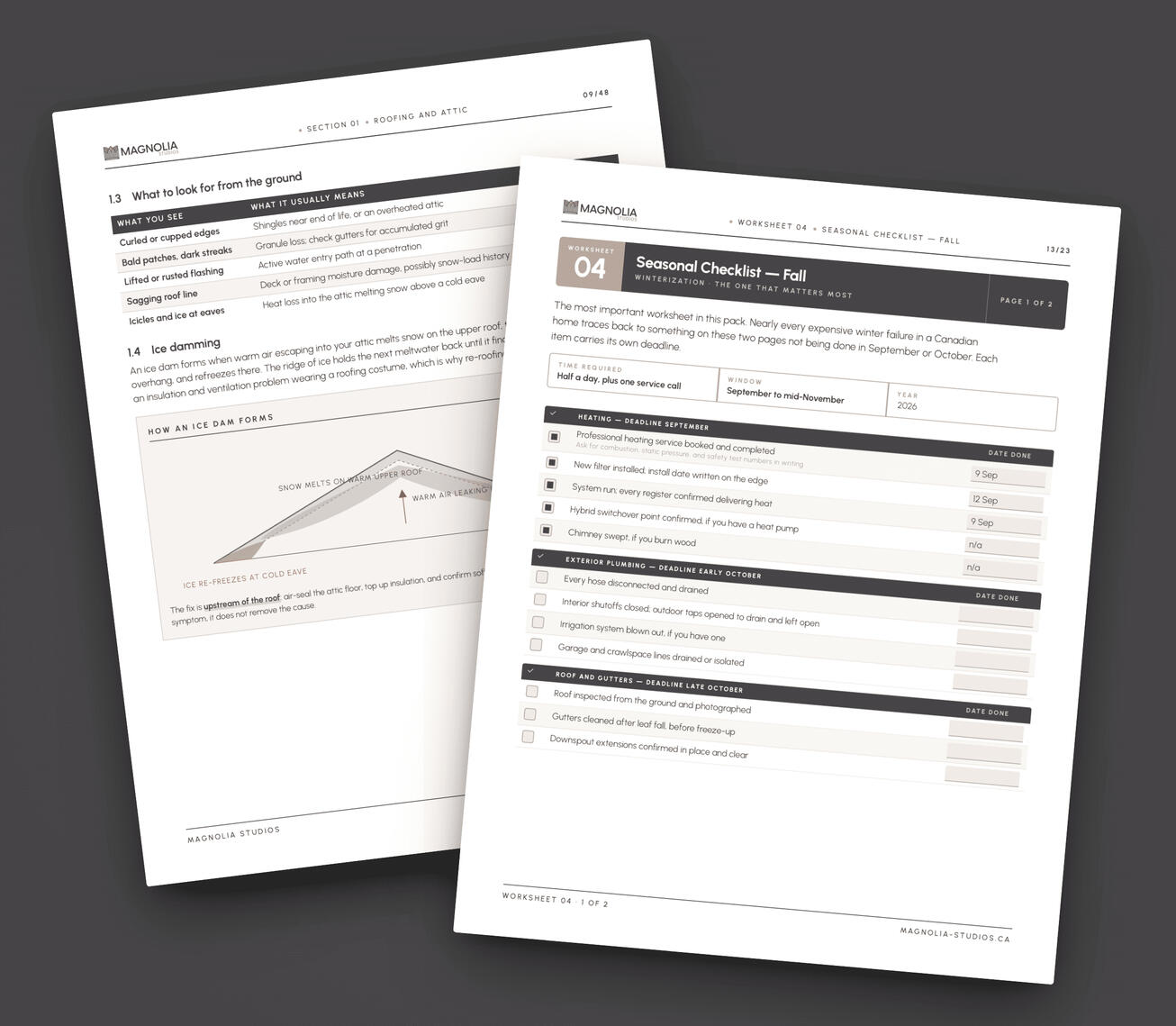
10 worksheets across 23 pages, and every field on every one of them types on screen.Fill them in on your device as you walk the house, or print them out for good old handwritten notes.The full walkthrough takes about an hour, once a year.Do it once and you have a list,but do it again next spring and you have a comparison. That's the part that tells you what's actually changing and keeps you on top.The worksheet tells you what needs doing, working out what it should cost is the other half.
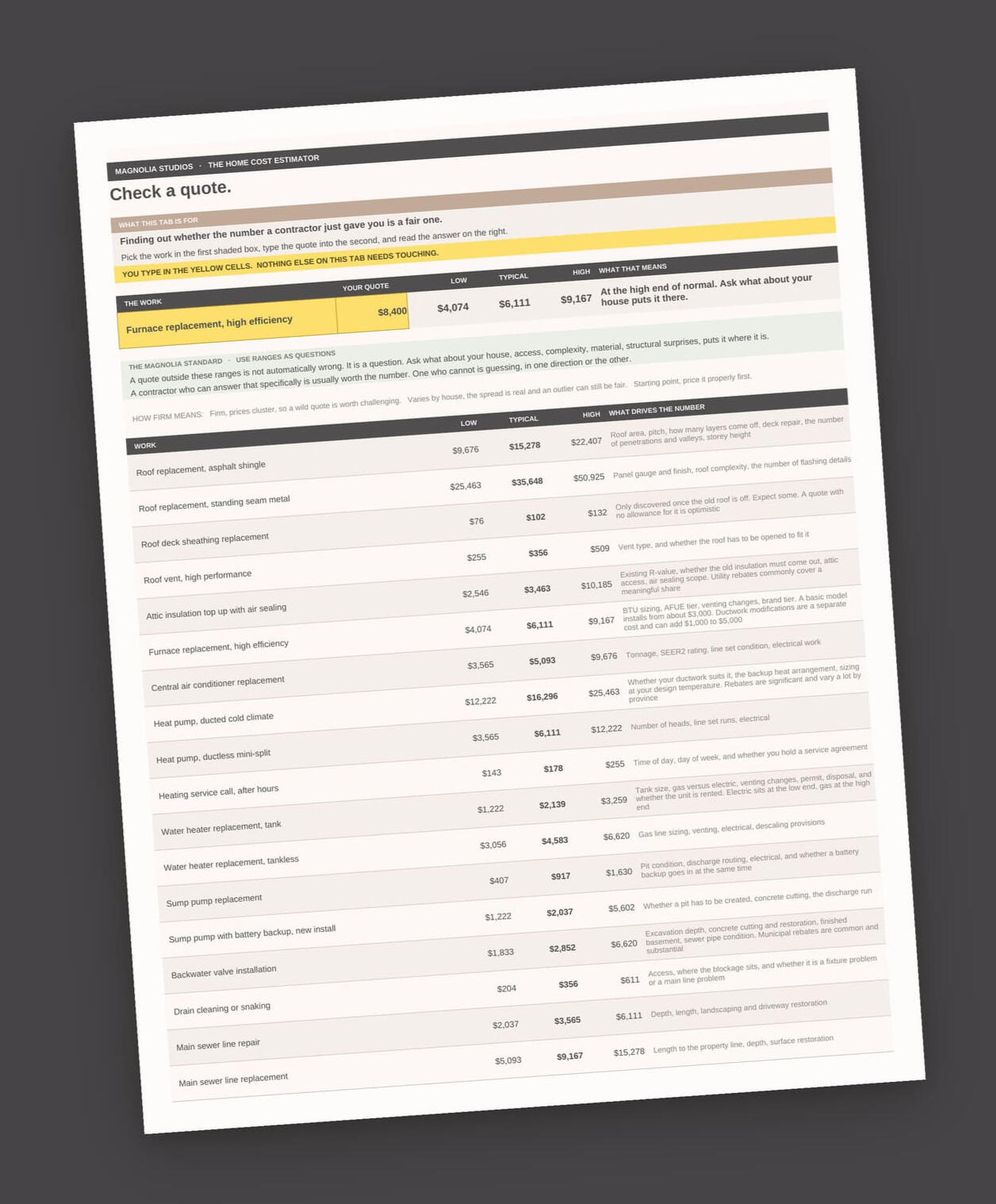
That is one of five tabs.Forty-seven jobs are priced in it. Roofs, furnaces, water heaters, panels, sewer lines, windows, etc. The work that costs real money.A second tab covers the small stuff. Thirty-seven jobs you do every year or every few years, filters through to a chimney sweep, added up so you know what a normal year will cost you.A third turns that total into a monthly number. That's the amount to put aside, so the bill is never a surprise.And Worksheet 09 lines up your big replacements: when each one is due, and what it should cost.And every price moves with where you live. Thirteen provinces and territories, and four kinds of place inside them, from a major city out to properly rural. A furnace in Nunavut is not the same price as a furnace in Saskatchewan.The last tab shows where every number came from. Eighteen sources, all named with what each one was used for.You never have to take my word for a figure. You can go and check it.
$99 CAD
One Time · Instant Download · 30-day refund
Here’s what’s different once you have it.You walk the house twice a year with a list, rather than waiting for something to announce itself.When a quote shows up, you already know the range it should land in.You get to decide what gets done this year and what waits, with intention.And you stop finding out what your house needs from the person selling you the repair.
The Reference Guide

I'm not going to put a countdown on this page.Nothing here expires at midnight, and the price won't change because you left and came back.The season, however, is a different matter.
Your house runs on a calendar whether you keep one or not.Every season does something different to it, and every season has a short stretch where the right work is straightforward and cheap. Miss the stretch and the same job costs more and waits longer.Knowing which stretch you are in is most of the job.The list won't expire, but the windows will.
So here's my whole offer.$99 CAD, once. That's less than one after-hours plumber visit.
One Time · Instant Download
30-Day refund - no questions asked
The guide, the worksheet pack, and the estimator.All three available the minute you pay.You pay once. No subscription, no account, and nothing to cancel later.You download three files and they're all yours.Plus thirty days to change your mind.Open all three, walk your house, and put a real quote through the estimator.If it's not worth what you paid, reply to your receipt and I'll refund you.Keep the files anyway. I'd rather you have your money back than pay for something that wasn't right for you.And when 2027 prices land, I will rebuild the estimator.Once, free, sent to everyone who bought the system. This year's prices are next year's guesses.

One last thing, and then I will leave you alone.Nothing on this page is urgent.Your house will look exactly the same tomorrow whether you buy this or not.Yet that's the whole problem.The crack that costs five hundred dollars and the crack that costs eight thousand look identical.The only difference between them is how many winters went by while it looked fine.A third of the country is worried about their home flooding. Many have no plan for it.If you close this page now, that's the group you may be in tomorrow morning.You care. You were just never given the list.Here it is.

Thanks for reading a full page about furnace filters and foundation cracks. That's not a small thing to ask of anyone.It means you're taking your house seriously, which is the whole point.Philip Mitchell